For years we confused seeing with knowing. If something appeared in an outlet or travelled with enough force, we took it as valid. The internet amplified that habit and AI has finished breaking it. Today an image, a text or a video no longer proves anything by itself. Not because everything is false, but because everything can be.
When anything can be generated, nothing is validated just by existing.
The immediate reaction is usually rejection or fear: widespread distrust, digital fatigue, information overload. But there is a more interesting reading. When digital stops being reliable by default, judgment matters again. We ask for context, contrast, traceability. And we look for signals that a prompt cannot generate.
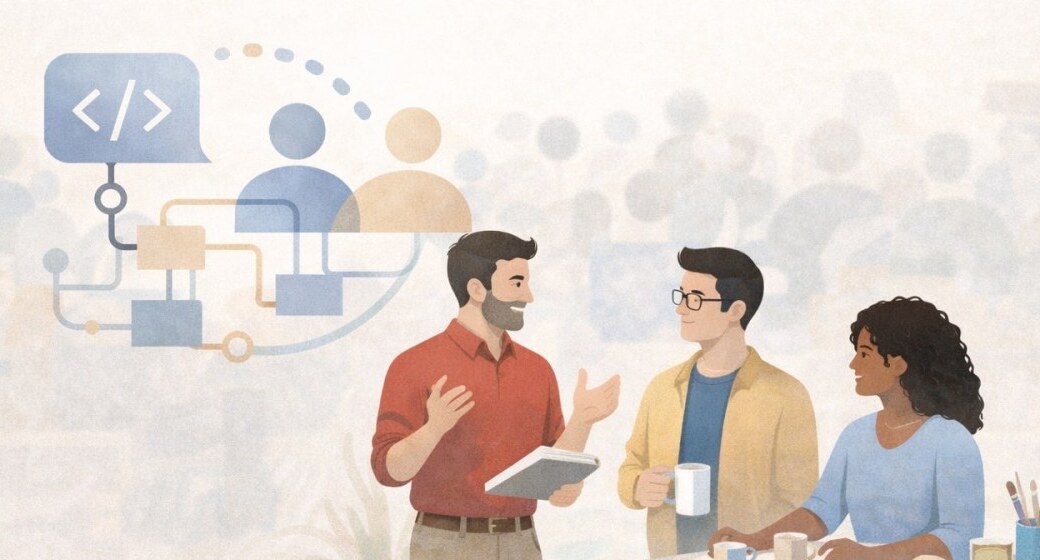
That is where the human gains weight again, and not out of nostalgia. Face-to-face conversations, shared spaces and time invested without shortcuts become relevant again precisely because they cost effort, take up space and demand presence. Being there is still a proof that is hard to fake.
What demands time, space and presence becomes relevant again.
Movements in that direction are already visible: more small meetups, more workshops, more communities that put continuity above one-off impact. Less passive content consumption and more real participation. It is not a rejection of technology, it is the complement you need to keep your bearings.
At Arcasiles Group (opens in a new tab) we have approached it that way from the start. Events and community not as a shop window, but as human infrastructure: places where people meet, talk, disagree and build something shared. Where technology sits alongside the work, but does not replace the relationship.
When digital stops being enough, the human becomes central again.
Maybe we are not losing the truth, but learning to demand it in another way. Less blind trust and more responsibility. Less noise and more presence. And that, far from being a problem, may be good news.